How often do you think about how your life could be different?
I’m not talking about a vague "someday" wish. I mean those real, unfiltered moments like when you try on a pair of pants that used to fit, or you look at a project that’s been sitting half-finished for months and you think, "If I just stuck to the plan...". We all have these visions of a "future self" who is more organized, healthier, or more courageous in their career. But for most of us, that amazing dream remains trapped as a question of "what if?". We shrug it off, go to work, and move on, only to find ourselves replaying the same cycle a few weeks later.
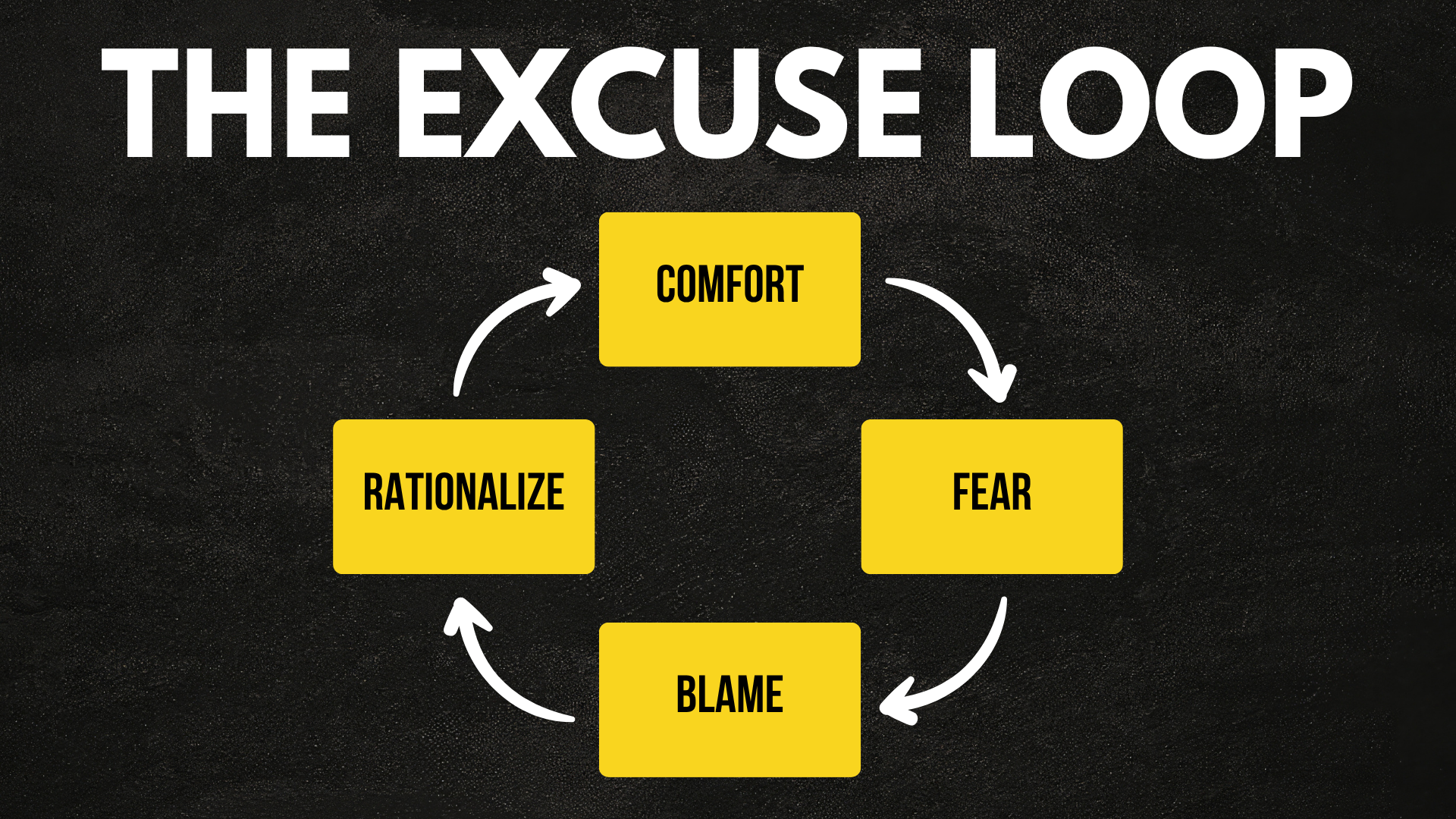
In my book, The Excuse Index, I explore why these cycles are so addictive. We are caught in a self-perpetuating cycle of "small, well-dressed lies" that keep us exactly where we are. I call it The Excuse Loop.
The Anatomy of the Loop
The Excuse Loop isn't just one moment of hesitation, procrastination or laziness. Rather, it is a four-stage defense mechanism designed to keep you safely, but frustratingly, stalled. To break the cycle, you first have to recognize how it’s playing out in your life.
1. Comfort (The Baseline)
This is your "baseline," or your safe zone where nothing feels at risk, but also nothing is changing without any action. In a career sense, you’re at your desk and you feel that spark to finally apply for that leadership role or pitch that big idea you’ve been sitting on; you think, 'I really have what it takes to make an impact here.' In a health sense, you’re on the couch after dinner and you think, 'I really should go for that run I promised myself this morning.' In this stage, the dream feels good because it’s still just a thought.
2. Fear (The Resistance)
The moment you reach for the 'apply' button or your running shoes, you hit Stage 2: Fear. This is your survival instinct treating change as a threat. Your heart sinks and you think: 'What if I’m not actually qualified? What if I get rejected and everyone at the office knows I tried and failed?' Or you look at the door and think: 'It’s going to be cold. I’m going to look ridiculous struggling down the street. What if I can’t even finish a mile?' Fear’s entire job is to make the 'What If' feel dangerous so that you will stop.
3. Blame (The External Shield)
To stop that fear from making us feel bad about ourselves, we move to Stage 3: Blame. We look for an external source to point at so we don't have to face the internal resistance. You look at your workload or your bank account and say, "I can't apply for that role because the company isn't promoting anyone in this economy," or "My boss already has a favorite, so why even try?" Or you look at the weather or your gear and say, "It’s already 6:30; if it weren't so dark outside, I’d go," or "I don't have the right shoes for a run today anyway." By pointing outward, you’ve convinced yourself that you aren't the problem…the world is.
4. Rationalization (The Well-Dressed Lie)
Finally, we reach Stage 4: Rationalization. This is where we wrap the excuses up in a bow so we can go back to the way things were. You conclude: "It’s actually the responsible choice to stay in my current role for another year; I'm being wise by waiting for 'perfect timing.'" Or you tell yourself: "I worked hard today and rest is a form of recovery, right? I'll just do a double workout on Monday." This settles the mental conflict, the guilt vanishes, and you slide right back into the Comfort stage. Loop closed but the frustration continues day after day.
Go Deeper: In Chapter 5 of The Excuse Index, I break down exactly how these four stages reinforce each other and why your brain is biologically wired to choose the "safe" lie over the "risky" truth.
The Recipe to Break Out
Breaking the loop doesn't require a giant leap or a perfect plan. It requires three simple shifts in how you approach your next move:
Acknowledge Choice: Recognize that while you can’t control the economy or the clock, you have one hundred percent control over your next move.
Reduce the Starting Friction: We often mistake the "drag" we feel before starting for a lack of motivation, but you just need a "If-Then" plan. If I feel the urge to blame the weather, then I will put on my running shoes anyway. If I feel the urge to doubt my qualifications, then I will open the application link anyway. You aren't waiting for the "feeling" to change; you're just executing the trigger.
The Simple Start: Focus on a "menial task" rather than the finish line. If the goal is that new leadership role, don't try to rewrite your entire resume today; just open the document and update your contact information. If the goal is that run, don't worry about the three miles; your only job is to tie your laces and step onto the porch. That’s it. You are shrinking the challenge until the excuse sounds ridiculous.
Your Future Self is Waiting
Today is the day you stop looking for reasons why you can't and start looking at the one small choice you can make. You have the power to flip the switch and rewrite the story you’ve been telling yourself. If you’re ready to stop letting excuses write your future, I invite you to pick up a copy of The Excuse Index: The Stories We Tell Ourselves to Stay the Same. It is a full roadmap for anyone who is tired of being their own biggest obstacle.
What is one "menial task" you can complete in the next five minutes to break your loop?
Let's do this.