
If you take a look on your LinkedIn feed right now and scroll for thirty seconds, you know exactly what you’re going to see. It’s usually a highly stylized graphic of a quote that says something like: "Managers don't deserve loyalty; they have to earn it." Or, "If a company doesn't see your worth, pack your bags."
They are everywhere. And they get thousands of likes because they feed into a very appealing narrative: If your career is stuck or you aren't getting promoted, it is 100% the company’s fault.
It’s an attractive mindset because it requires zero personal risk and lets you off the hook. It allows you to tell yourself "I am a perfect employee, they just don't see it." Boom. Instant dopamine hit. "I'm not the problem here, it is them."
I mean, this is how I thought at one point in my career, so I'm no saint here. But I've been in consulting and leadership roles long enough to know there are there are always two sides to the story. I think it’s time we drop the excuse for a moment, take on some real personal ownership and look at the other side.
Before you demand that a company respects your "worth," you have to look in the mirror and ask a very uncomfortable question:
Your numbers/results might be great, but is the energy it takes to manage your personality, drama, and complaints making you an exhausting employee?
Another way to put this is if when you call your manager, do they look at the screen and have to ask "do I really have the energy to talk to them right now?" The reality the LinkedIn quote-gurus leave out is that leaders don't evaluate you based on your work production alone. You might be an expert in your field, but if you are constantly bringing drama, you are not promotion-worthy material.
The Grid
If we strip away all the corporate HR fluff, in my opinion, your professional reputation comes down to where your dot lands on these two axes:
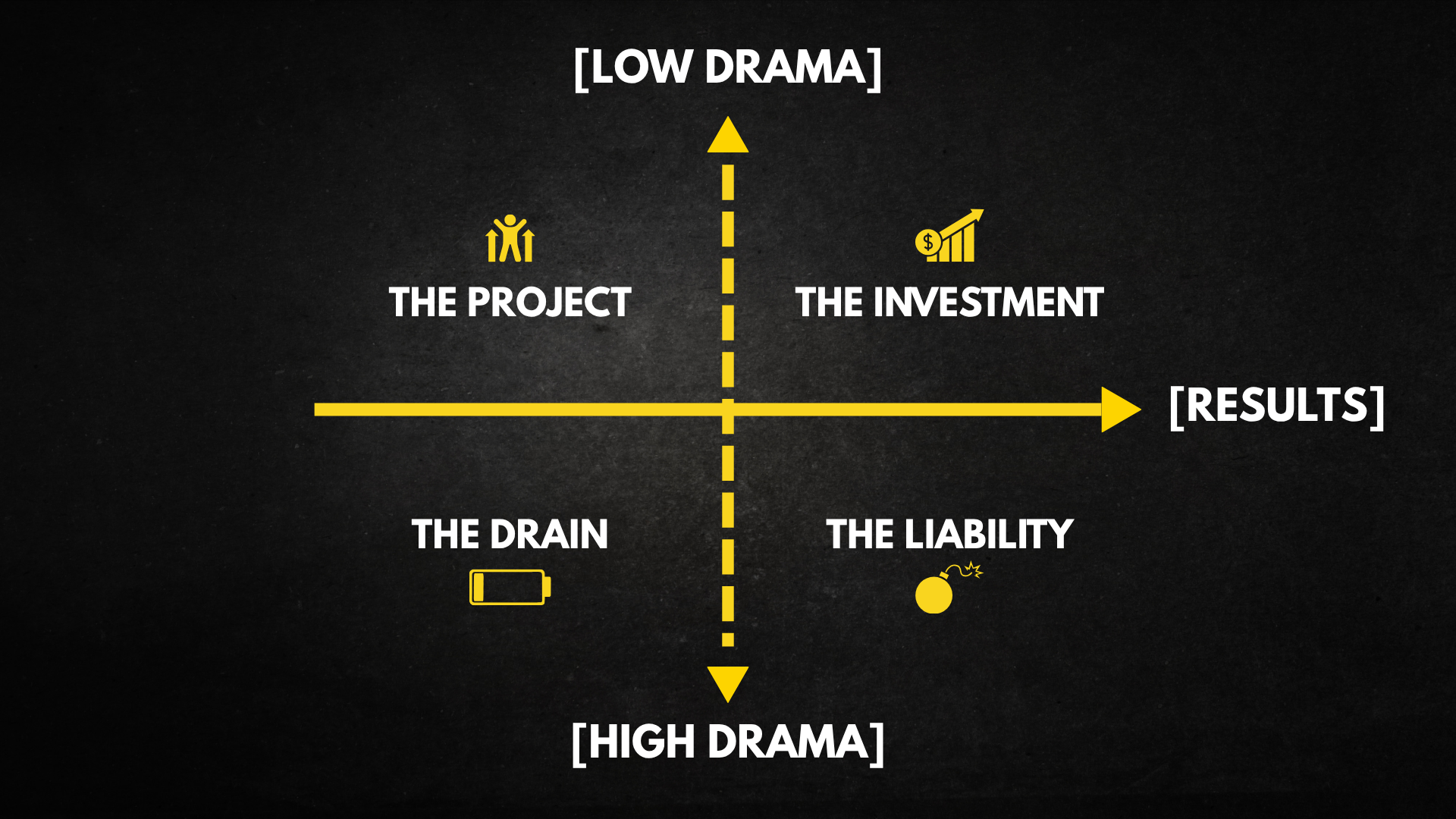
Results (The Horizontal Axis): Can you do the job? Do you hit the deadline? Is your work customer-ready, or does your boss have to spend an hour fixing your mistakes? This is your technical output.
Drama (The Vertical Axis): This is your required emotional maintenance, or how much energy does it cost your manager just to get those results out of you?
When you map them together, you get four professional archetypes.
1. The Investment (High Results / Low Drama)
Description: Extreme Ownership. These are the professionals who operate like a "Company of One" inside the organization. When an ambiguous problem hits their desk, they don’t wait for a step-by-step checklist or push back because it "isn't in their job description." They own the outcome.
How they communicate: Their updates to leadership are clean, proactive, and structured to facilitate quick decisions. They don’t dump a broken process on their manager’s lap and walk away; they say, "Here’s the issue, here are the two solutions I’ve vetted, and here is my recommendation. Let me know if you want to pivot."
The Impact: They are a literal force multiplier. They lift the emotional weight of the room during high-stress crunch periods by keeping a steady head and setting a calm, task-focused tone.
2. The Project (Low Results / Low Drama)
Description: High Potential. These are your eager learners, your junior team members, or people transitioning into a brand-new role. Their output or tribal knowledge might not be at peak capacity yet, but their attitude makes them an absolute joy to mentor and lead.
How they communicate: They ask intelligent, targeted questions to learn, instead of avoiding work. When they receive tough constructive feedback, their default response is curiosity. They look for opportunities to listen and then say, "Got it, how do I apply that next time?" and update their process immediately.
The Impact: Managers willingly pour time and resources into a Project because the professional ROI is a guaranteed win. The attitude is already there and the skills are just a matter of time.
3. The Drain (Low Results / High Drama)
Description: Constant Issues. The classic liability-in-waiting. These individuals are missing deadlines, producing subpar deliverables, or requiring constant hand-holding just to get the job done. However, they also possess a highly exhausting list of excuses for why it’s never their fault.
How they communicate: They spend more energy critiquing the organization, the tools, the timelines, and their coworkers than they do actually delivering. They are the ones who join the "LinkedIn Quote Brigade" to loudly complain about what the company isn't doing for them. Ironically, they are completely blind to the fact that they haven’t delivered basic value to their organization in months.
The Impact: They drag down team momentum, create toxic side-bar chats, and slowly pull energy away from high-priority initiatives because leadership is constantly forced to micro-manage and over manage. In short, they are exhausting.
4. The Liability (High Results / High Drama)
Description: Toxic Asset. This is the danger zone, because these individuals are genuinely talented. They hit their quotas, they write great code, or they possess deep company/department knowledge. Because of this high output, they fall into a massive blind spot in that they think their skill set makes up for their behavior.
How they communicate: High-maintenance. If leadership alters direction in strategy or announces an unexpected change, this employee immediately and publicly undermines the decision. Every 1-on-1 meeting feels like walking through a minefield where the manager has to tiptoe around their ego or provide an intense therapy session just to keep them motivated.
The Impact: They charge a massive "emotional tax" on the manager and the organization. While they might deliver a good product, they destroy the team's culture and run their manager's battery completely to zero.

The Real Cost of Doing Business
The hardest part about this grid is realizing that the people who occupy the bottom half (The Drain and The Liability) have absolutely no clue they are down there. If you're a Drain, you genuinely believe the system is rigged against you, completely oblivious to the fact that your constant complaints are sucking the life out of the room. If you're a Liability, you think your high performance buys you a pass to be difficult or negative. You look at your metrics, see a green dashboard, and assume your behavior doesn't matter.
But a green dashboard doesn't erase a toxic personality, and a pile of excuses doesn't replace a lack of results.
When your manager has to spend half their week managing your ego, navigating your resistance to change, or psyching themselves up just to hop on a call with you, they aren't looking at you as an asset. Whether you have high results or low results, if you are on the bottom half of that grid, you are exhausting.
While it may be difficult to accept, and at the end of the day, a company is just looking to get a return on investment for every employee they hire. If the emotional maintenance cost of keeping you exceeds the value you bring in, you are a risk. And leadership will always figure out a way to reduce (or remove) risk.
The good news? If you just realized you’ve been dragging the team down, you don't need to go out and get a new certification or endure some intense training to fix it.
Breaking the Cycle
If you want to move out of the bottom half of that grid and start tracking toward The Investment, it comes down to two immediate changes:
Change how you communicate problems: The next time a something breaks, pay attention to what you actually send your boss. Do you fire off a frantic "everything is broken and I'm overwhelmed" message that basically forces them to stop what they're doing and attend to your mess? Or do you take ownership, look at the problem, and bring them two actual options on how to fix it? Stop making your manager do your thinking for you.
Drop the "Me vs. Everyone Else" mentality: Stop treating every change in priority or piece of tough feedback like a personal attack on your character. When you assume that leadership is out to get you, or that your coworkers are actively trying to make your life harder, you become so defensive that it is exhausting just to have a conversation with you. Your manager isn't your enemy, and a correction is just a reality of doing business. Take the feedback, make the adjustment, and move on.
After all of that, where do you think you actually land on the grid?
It’s easy to read an article like this and assume it applies to your coworkers, not you. Self-awareness is hard but it is important to rely on the facts to ensure you correct the right things.
I’ve built a live, 10-question Reality Check diagnostic tool that takes about two minutes to click through. It cuts right to the point and will give you an honest baseline of exactly where you land on the Results vs. Drama scale.
Go take the test here: 👉Reality Check
Need a Kickstart?
The Full Playbook: If you took the Reality Check survey and realized you’re stuck in the Drain or Liability quadrants because of a laundry list of excuses, grab your copy of The Excuse Index. It’s the full tactical playbook to help you take ownership, and get moving once and for all.
The Future-Self Framework: Ready to move yourself up on the grid and become a true Investment? Access my free Future-Self Framework to design a daily operating manual to help you take your big goals and break it down into easy-to-consume tasks.
The Excuse Breaker on YouTube: If you’d rather watch than read, I break down these exact quadrants, workplace dynamics, and leadership strategies visually on my YouTube channel.
Blog Archive: Looking for more no-nonsense tactics to crush your goals? Read past articles from my blog, The Excuse Breaker.